Monday, January 11, 2010

Native Foods Cafe - Tustin

Self-deception. That was the theme of a recent Saturday morning I had. First, it was Up In The Air, the excellent film with George Clooney who's self-deceiving mission is to believe that he needs no one and nothing. Then, for lunch we ate at Native Foods Cafe, a restaurant within steps of the AMC at The District, which allowed us, for an hour, to really believe that we did not need to eat meat.

(SPOILER ALERT) And like Clooney was for the first half of the movie, we were content to live in the delusion. But unlike him, our story had a happy ending.

We destroyed our nachos like as if it came from Alerto's itself (our go-to joint for the king of all faux-Mexican dishes). And if we were blindfolded eating it, we'd tell you it was just nachos. Nothing about the main components really deviates from what's already part of, say, a carne asada nacho. This was real pico de gallo, real guacamole, real corn, real black beans and real tortilla chips. Though I figure they'd use lardless tortilla chips, it crunched and shattered in shards just the same.

The only innovative component was the sour cream, which wasn't dairy-based, but made out of something that cannily approximated it. My tongue told me it tasted like a cross between creamy bean dip and hummus. And subbing for meat, there were light-brownish, textured curdled pieces of a substance that almost fooled us into thinking that we were chewing of the flesh of a creature that once walked, flew or crawled.

Same thing the margherita pizza, which I have to conclude is the work of an alchemist. How does one get a milkless cheese to melt? I have no idea. And neither do my friends. We just agreed this wasn't just a good vegan pizza, but a good pizza. The crust crackled. The pesto bit. The marinara, respectful.

Chicken wings, tube-like spears of soy protein masquerading as fingers rather than wings, were battered well and was still more chicken-like than McDonald's McNuggets.

About the only thing I didn't dig was the watermelon agua fresca, which had a grassy flavor that distracted from its sweetness. It was as if the whole green rind was included in the blender.

So yes, we deceived our carnivorous selves into not eating meat and were happy for it, not to mention full. The combo of Native Foods and Up In The Air, I dare to say, was even more fulfilling than a burger and Avatar.

Native Foods
(714) 259-0400
2453 Park Ave
Tustin, CA 92782

THIS WEEK ON OC WEEKLY:
Continental Deli - La Habra

Wednesday, August 10, 2005

Childhood Memories

To me, no memory from my childhood is more vivid than those that are related to food. But of course, since I lived in Indonesia until I was eight, all of my childhood memories of food involves nothing but those from my native cuisine.

So to Kirk from mmm-yoso, who tagged me for this meme, just a warning: the food I will write about might be a little foreign to you (as it will be for anyone not from Indonesia), but oh well, I had fun writing it anyway!

And oh yeah, here's another set of rules and disclaimers by the initiators. I feel like the stuff in quotes below should be read by the guy who-talks-really-fast-at-the-end-of-over-the-counter-medicine-commercials-so-that-you-don't-actually-listen-to-it:

"The rules of this meme are simple. Write about five foods from your childhood that you miss...what's the catch? There is none, really. AND so that the people that started this darned thing can keep track of it, here's something else that you need to do:

Remove the blog at #1 from the following list and bump every one up one place; add your blog's name in the #5 spot; link to each of the other blogs for the desired cross-pollination effect. Then tag three people and you're over and done with it all."


1. BeautyJoyFood
2. eat stuff
3. 'Ono Kine Grindz
4. mmm-yoso!!!
5. Monster Munching

FOODS OF MY CHILDHOOD

1. Martabak Telor

Sold only at the night markets on the streets of Semarang, by the flickering flame of a gas lantern, this pan fried snack starts out with a pliable dough. Expert hands then stretch and work the dough into a thin membrane as wide as a bed-sheet. It is slapped onto an oiled griddle and then a curry-seasoned mixture of minced meat (usually goat or beef), green onions, and beaten egg is spread thinly on top. The excess flaps of the dough sheet is quickly folded over and after a few minutes of cooking, this flat mass transforms into a crispy melange of goodness. It is then cut into rectangles, perfect for finger snacking. Not quite an omelette; not quite a pancake; not quite an egg roll; but exhibiting the characteristics of all three. You might have seen Tony Bourdain trying and loving a similar dish during the Singapore episode of A Cook's Tour.

2. Sate Gule Kambing

This is actually two dishes made from goat ("kambing"); one is a soup and the other is grilled. Eventhough both dishes are unique in and of themselves, these two distinct preparations are meant to be eaten together. Like "fish and chips", you simply cannot have one without the other. Unlike fish and chips though, the soup is the "yin" to the sate's "yang". The whole meal becomes a perfect balance of asymmetric flavors and textures. The soup, called gule (pronounced 'guh-lay'), is curry-based. Made from simmering the bones and fatty, gristly meat of the goat in a big pot, it is rich and unctuous. But the consistency is surprisingly thin, with a subtle creaminess coming from coconut milk. The sate (pronounced "sa-tay"), on the other hand, is simply prepared. To make it, the most tender pieces of the goat is cut and threaded onto bamboo skewers. Then the skewers are cooked quickly over a charcoal fire. As soon as they are done they get brushed with a glaze made from a mixture of kecap manis, lime juice, and white pepper. The two dishes are enjoyed in concert with hot rice. I alternate between tearing a chunk of meat from the sate with my teeth and then taking a sip of the hot soup.

3. Soto Ayam

This is probably my favorite Indonesian dish of all. The best version, in my opinion, comes from my hometown of Semarang. In a ramshackle structure built of spare aluminum siding and tattered fabric, the family that owns this street-side "warung" wakes up every morning before dawn preparing simmering vats of soto, a shredded chicken soup seasoned with turmeric and other spices. Order a bowl and you see them assemble your breakfast. Rice, bean thread noodles, celery leaves and diced green onion go in first. Then it is doused with the clear, hot soup, garnished with crumbled fried garlic and shallots. But no bowl of soto is complete without some sort of side dish. The most common one is perkedel, a deep-fried mashed potato fritter. My favorite side dish, though, is a bowl of stewed bloody-clams and boiled egg. The kecap manis it is steeped in imparts a deep, sweet flavor and a dark, brown color; the perfect accompaniment to the bright yellow of the soup.

4. Nasi Pecel

This dish I remember because I ate so much of it one day on a trip to Surabaya that I was literally rendered motionless with a food coma. My mother chided me for gorging myself to this state, but I didn't care. Heck, I ate the same amount the next day. How could I resist this salad of boiled kangkung (Chinese watercress), bean sprouts, and string beans, dressed in a peanut sauce that was spiked with chilis, tamed with coconut milk, and made addictive with other unknown spices. This dish harnesses the non-translateable Indonesian word "SEDAP!". The closest I can get to an English translation is "lip-smacking, mouth-watering, refreshing, and savory." And even that doesn't do it justice! And oh yeah, no plate of nasi pecel is complete without kripik kacang, a typical accompaniment; a thin sheet of fried crunchy batter dotted with peanuts.

5. Nasi Ayam

This dish holds a special place in my heart because I remember eating it outside my grandmother's porch in Semarang. The nasi ayam lady would come around with her wares dangled on a long stick slung over her shoulder. After taking a seat on a portable stool, she'd peel a single banana leaf, tuck one side over the other, making a cone. Inside this cone, she would scoop a little rice, pour on some opor ayam, which is a thick soup made with coconut milk and chicken, quarters of boiled egg, and stew of julienned chayote, tofu and chilis. Then I'd eat the dish with a "spoon" improvised from a strip of banana leaf, folded and creased into a rudimentary scoop.

Pam of Daily Gluttony, MealCentric (he's on vacation), Diamond Dog, "Tag. You're it."

Monday, December 20, 2010

Merry's House of Chicken - West Covina

Go forth fellow Orange Countians, out of your comfy cul-de-sacs, to the equally quiet foothills of West Covina. There you will find the Southland's newest Indonesian restaurant, peddler of foods from the spicy archipelago and a fried chicken specialty that will result in more return trips north.

The chicken dish in question ayam goreng kremesan, which roughly translates to "fried chicken with crispy crumbly things"--a golden brown, half-bird deeply seeped of its marinade and showered with the granular crumbles of its disembodied crust. Think of this addictive substance also as a seasoning, because it is. This crisp rice-flour-based batter sings the same notes that the bird does, but concentrated in a molecular sense, a flavor present in every explosively crunchy, tempura-crossed-with-granola crumb.

This is the same kind of chicken that begat KFC-like empires in Indonesia, the least of which is called Ayam Goreng Suharti, arguably the closest thing Indonesia has to a homegrown Colonel Sanders.

Dollop each morsel of bird you tear off from the well-fried carcass (note: Indonesians prefer their chickens fried to the point of dryness) with the house-made sambal, an intensely sweet, and intensely hot chili and tomato paste inflected by the stinky, funky, umami-rich accents of terasi, Indonesia's indigenous fermented shrimp paste. Instantly, your lips numb, your tongue blazes, your brow begins to dampen. And yet you add more, and more, finishing the first saucer and asking for seconds. You admit to yourself that you can eat this homemade fire balm for days, your internal organs be damned.

Your tastebuds will not have fully recovered when you move on to the other dishes, like the nasi goreng petai, a fried rice dish with little bits of noodle, meat, chili, and most notoriously, petai beans (sator beans), a fragrant, nutty tropical legume with a lima-bean-like texture, and a propensity to make your pee smell worse than if you ate a whole bushel of asparagus.

And since you're already drenched head to toe in your own perspiration, Merry Istiowati--the Surabaya native who, by the way, opened this ode to the poultry (and Indonesian cuisine) after closing 368 Noodle House so many years ago--makes an estimable nasi bungkus, banana-leaf-wrapped-rice, which is what a take-out meal would look like if drive-thrus existed in the jungle. But be warned: this is a dish as piercingly hot and sweat-inducing as noontime in the tropics.

Once you unfurl the butcher paper and leaf packaging, you see a green-chili sambal waiting furtively, nay, dangerously in one corner. A hard boiled egg is stewed in more chili. A piece of beef rendang is covered with its cooked-down brown seasoning paste. On top of the pile, a turmeric-colored chicken leg and a spoonful of curried vegetable provides the only non-spicy reprieve. All are heaped into a football-mound of rice which has taken on the vanilla-like perfume of its botanical container.

It's about then you thank Merry's House of Chicken for supplying an ample amount of sweat-blotting napkins in a convenient basket next to the kecap manis.

Merry's House of Chicken
2550 E Amar Rd., Ste A5
West Covina, CA 91792
(626) 965-0123

THIS WEEK ON OC WEEKLY:
Happy Family - Costa Mesa

Monday, November 06, 2006

Poke Here, Poke There


Poke (pronounced poh-kay) is as indigenous to Hawaii as the coconuts and the world-class beaches. The dish is made up of nothing but cubed raw fish, usually ahi tuna, simply seasoned with sea salt and slender slivers of seaweed. It's essentially no-frills sashimi, enjoyed by its native fishermen for centuries, but popularized by perfunctory hotel luaus and celebrity Hawaiian chefs like Sam Choy.

I recently came back from my first trip to our 50th state, where I ate this local delicacy in the quaint town of Hilo, after being empowered by Kirk of the über-food blog, Mmm-yoso, with a roadmap of foods to try and places to try it.

Poke was a high on the list of priorities, but eating it where locals like Kirk would eat it was even more important to me than swimming in the most secluded beaches or snorkeling the bluest lagoons. He suggested KTA, a supermarket chain which sells the stuff by the pound, with locations throughout the Big Island.

But weeks before I even packed a single pair of shorts in my luggage, I went in search of poke in Irvine. And I found it at Nalu's Island Grill, in the Quail Hill Village Center. Here was a poke primer and it was no more than a few clicks away from home.

Which poke was better? Well, it's no contest really. But to be fair, what I had at Nalu's, because of the way I chose to have it, wasn't technically poke in the most traditional sense.

And as for KTA's poke, in addition to weilding the homecourt advantage, the fact that I was eating it while on vacation made it just that much more delicious -- everything tastes better when you're on vacation.

Here's the breakdown.

NALU'S ISLAND GRILL

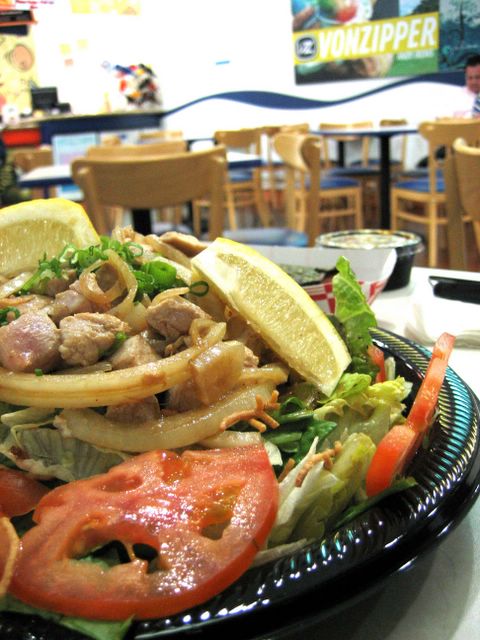
Its walls plastered with posters of surfers riding cresting waves and an atmosphere reeking of Von Zipper hipness, Nalu Island Grill's main attraction, as with most Hawaiian joints, are the plate lunches. But my eyes immediately locked onto the words "Ahi Poke Salad" like a sailor lured by sirens.


The total sticker price was $7.49, and comes with the ahi either "rare" or "seared". Going against the concept of poke, I chose it seared. And as expected, the tiny chunks of tuna were cooked on a griddle to an opaque and pearly white, each morsel the size of a dinner mint. Placed on top of a bowl of greens with sliced tomato, wilted slivers of onion, diced scallions, and some crunchy fried noodles, the poke was more salad than poke. But it was refreshing nonetheless, introducing me to the dish in baby-steps.

The dressing -- a mix of soy, rice vinegar and sugar -- harbored a spicy bite and perked up the dish like an electric jolt to the system. The tuna, tasted like, well, like tuna; but a few notches above what you get out of a Starkist can. And although the dish had a Chinese Chicken Salad aura to it, its soul was still distinctly Hawaiian.

Nalu's Island Grill
(949) 854-8900
6741 Quail Hill Pkwy
Irvine, CA 92603

KTA SUPER STORES

Offered at the butcher's counter in the rear of the store and sold by the pound, poke at KTA comes in no less than a dozen dizzying varieties. There were different species and different flavors for the choosing, displayed in glistening mounds and scooped to order into small plastic tubs for weighing.


I had heard that poke is supposed to function as an appetizer or snack, but weeks of anticipation made my eyes bigger than my stomach. After picking out three pokes, we took our bounty outside to eat it on stone picnic tables located at the entrance to the market. With just a few wooden chopsticks in hand and iced bottles of water to wash it down, we gorged ourselves silly. Before we knew it, our poke snack became a full-fledged poke meal.


The Hawaiian Ahi Poke ($7.13) was the brightest in appearance and flavor. As catching to the eyes as polished rubies, the chilled cubes of ahi glinted in the sunlight, and soothed us to the very core with its clean taste and unmitigated freshness.

The measured use of seasoning only enhanced the experience. Dried chili flakes flecked each cube of fish, subjecting our palates to a subtle but slow burn; the crunchy bits of seaweed and sea salt added texture and flavor, respectively.


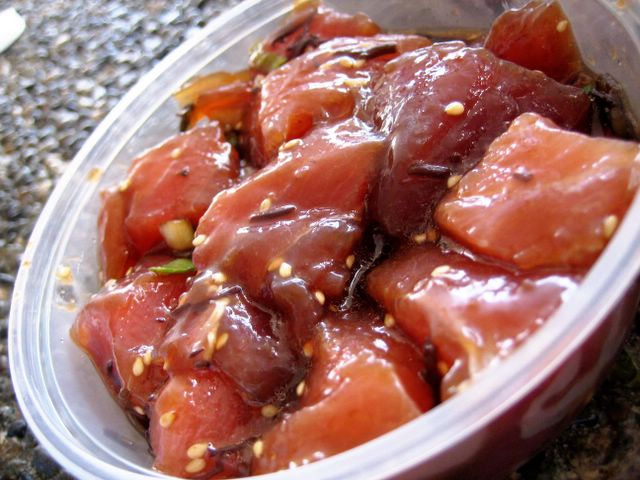
The Shoyu Ahi Poke ($6.36) was Korean influenced, with sesame oil and sesame seeds giving the raw tuna an oily sheen and a fragrant nuttiness. This and the soy sauce dominated the ahi, and caused it to taste more like marinated raw tuna, and less like poke. But the flavors were robust, bold, and rich. Although I still had an urge to take the whole mix to a hot wok for a quick sear.
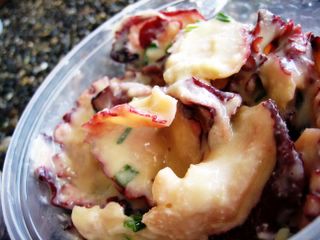


A surprising turn was the Tako Miso Poke ($2.63), which delighted and intrigued our tongues. Thinly sliced octopus tentacle was steeped in a deeply tangy and milky-colored miso paste redolent with the mysteriously addictive alcohol sting of white wine. The tender chew of the cooked cephalopod pleased us, especially because every piece of octopus we've encountered in the mainland has been as rubbery as an old tire.

After polishing off the last pieces of the poke, we took a long swig of water and watched as the coconut trees billowed in the tropical breeze.

We were in a supermarket parking lot in Hawaii, and we were on vacation.

KTA Super Stores
(808) 959-4575
50 E Puainako St
Hilo, HI 96720
To see more Big Island food PHOTOS,
--->>> Click HERE <<<---
During the slideshow, click on the middle of a photo to read my commentary.